
How the Palestine Action proscription case and the botched prosecution of Liam Óg Ó hAnnaidh show how the Home Office, the police, and the prosecutors, are not taking terrorism law seriously.
Terrorism law is important and should be credible
Let us start with the most basic point about terrorism law.
Terrorism law should be credible and taken seriously.
Terrorism law is a special body of law, in addition to the general laws of the land, conferring special powers and creating special rules in respect of the threat of terrorism.
As such, of all areas of law, it should be taken seriously and it should be credible.
*
The United Kingdom never really used to have terrorism law, at least in permanent form.
Instead we had, for example, a succession of temporary Prevention Of Terrorism Acts, of deliberately limited duration, renewed as and when by parliament.

And it was on this improvised legal basis that the United Kingdom dealt with the the terrorism that flowed from the “Troubles” in Northern Ireland, which came to an end to a large extent with the Good Friday Agreement of 1998.
Somehow those threats had been dealt with and a sort of resolution achieved without the need for any permanent terrorism legislation.
*
And then something changed.
And after 2000 the United Kingdom, year-on-year, created of body of permanent terrorism law, creating a security state within the state.
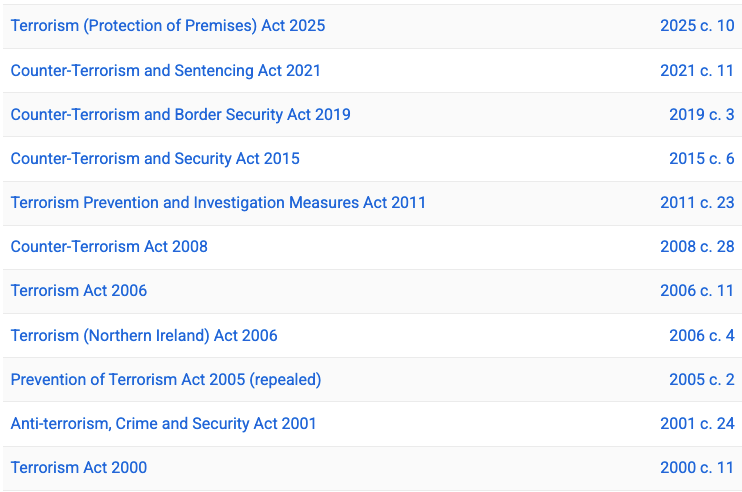
This was partly because of 9/11 and what followed - though the 2000 Act received royal assent before that dreadful tragedy.
And it was partly because of (perhaps counter-intuitively) the Human Rights Act 1998, which required all interferences with the fundamental rights of individuals to have an express legal basis. In other words, some of this stuff had been going on before, but there had been no statutory framework, as it had not been needed.
But after 2000, and for whatever reasons, permanent terrorism legislation grew like topsy.
Looking at the titles of the primary legislation, you may think that the “anti-terrorism” and “counter-terrorism” Acts would cancel out the “terrorism” Acts, but: no. The effect is accumulative.
In addition to the eleven Acts listed above from 2000 to 2025, we have had other extensive primary legislation on surveillance and data retention and national security.
According the the legislation website we have also had 163 items of secondary legislation with “terrorism” in the title since 2000.

Huge piles of new legislation on terrorism since 2000.
*
But, still, terrorism legislation should be taken seriously and be credible. Even if one can be concerned at the ever-growing extent of terrorism law, it serves - or should serve - an important legal purpose.
Terrorism legislation provides - or should provide - a special body of law for dealing with terrorism which cannot be done with the general law of the land.
*
The problem is that recent events have shown that terrorism legislation is not being taken seriously - and it is not being taken seriously by those who should take it seriously: the government, the police, and the public prosecutors.
And this is obvious from how section 13 and related provisions of the Terrorism Act 2000 (as amended) are treated by those with public power.
Here are three examples.
*
First, the proscription of Palestine Action by the Home Secretary was been ruled unlawful by the High Court.
(On this, see my posts here and here.)
The details of the High Court judgment show a Home Office that did not take the proscription seriously, imposing the sanction on flimsy or non-existent basis.
Even if the Home Office reverse this ruling on appeal, this is the sort of measure that should not have come anywhere close to a successful legal challenge.
The courts are usually deferent on matters of national security, and the judges were not impressed by Palestine Action, but even the High Court could not buy this proscription.
And this was because the Home Secretary and the Home Office did not take terrorism legislation seriously.
*
Second, the botched prosecution of Liam Óg Ó hAnnaidh, the Kneecap rapper, shows the police not taking terrorism legislation seriously.
(See my Prospect post from yesterday here.)

The police did nothing about an alleged incident for six months, even though supposed breaches of terrorism law should presumably be dealt with swiftly and diligently.
And then the police panicked at the six-month deadline for the relevant offence - and royally mucked up because they had not got the relevant consent in time.
From Kneecap to Keystone.

These are the same anti-terrorism officers who, of course, are supposed to be keeping us safe.
*
And then we have the public prosecutors in the same case.
When the defendant’s lawyers rightly pointed out that the prosecution was void for want of jurisdiction - because the requisite consent was not in place in time - the Chief Magistrate of England and Wales (no less) threw out the prosecution.
But the public prosecutors could not accept this decision.
Liam Óg Ó hAnnaidh simply had to be prosecuted for the alleged incident, no matter the cost to the public purse, and no matter the effect on settled case law.
The Director of Public Prosecutions resorted to the rarely used appeal by case stated to get the High Court to reverse the decision of the Chief Magistrate of England and Wales.
One would think that given the substantial delays and backlogs in the criminal justice system - some now lasting years - and which are seemingly so bad that the jury system itself may be dismantled - would mean that the Crown Prosecution Service would have better things to do.
But no, Liam Óg Ó hAnnaidh simply had to be prosecuted.
The High Court, however, were not impressed with the appeal.
The High Court pointed out that siding with the Director of Public Prosecutions in this matter would disrupt plain statutory provisions and settled caselaw.
The High Court even went to the extent of stating its “concern” at the “mistake” for which there should be “blame” in a classic passage of judicial understatement (emphasis added):
“It is a matter of concern that a charge which both the DPP and the Attorney General considered met both parts of the Full Code Test for Crown Prosecutors will never now be determined. There was, they decided, a realistic prospect of conviction and the prosecution was in the public interest. We have not investigated the reasons for this failure and nor do we seek to attribute blame. That is not because these circumstances are not worthy of consideration but because they are irrelevant to our decision.”
Ouch.
The Director of Public Prosecutions, of course, should not have wasted their department’s scarce (and valuable) resources on this hopeless appeal. The Crown Prosecution Service should concentrate on putting cases together, not trying to cover its back for when a mistake was made.
By the Director of Public Prosecutions and the Crown Prosecution Service pretending no mistake had been made (with an appeal based on an extraordinarily unconvincing case theory with no basis in any authority), they too showed they did not take the applicable terrorism law seriously.
*
By saying terrorism law should be taken seriously one is not denying that there is a purpose to terrorism law.
It is to say that terrorism law should not be taken lightly.
Credibility of any area of law can be fragile, and terrorism law deserves better than recent antics of the Home Office, the police, and the public prosecutors.
There's no "share" button so I haven't.
But I think this should be widely read.
Would you mind if it did escape into other social media?
As well as the CPS, perhaps the Ministry of Justice should also concentrate on other matters than a seemingly doomed appeal on the proscription of Palestine Action? Do ministers have to sign directions to civil servants to fund such appeals clearly brought for political rather than sound legal reasons?