
What the Palestine Action judgment means - and what it does not mean
The High Court rules against the government, but not with enthusiasm
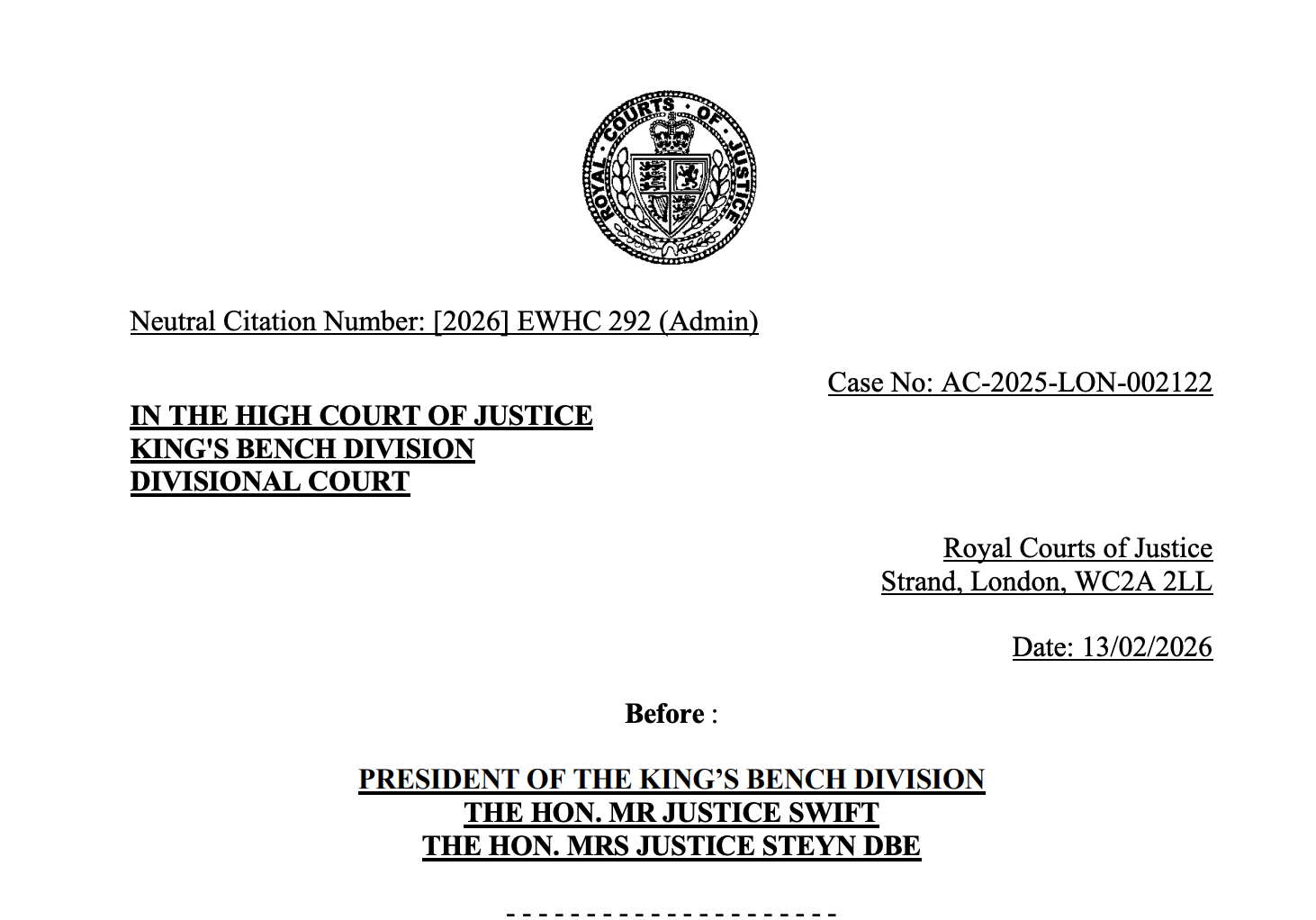
This morning the High Court handed down its judgment in the Palestine Action proscription challenge.
I wrote a quick commissioned piece at Prospect within a couple of hours of the judgment being handed down - and I just want to add and develop a few thoughts.
*
*
First, the judgment shows the independence of the High Court in two ways.
A ruling against the government by definition indicates the independence of the judiciary from the executive.
(For what it is worth, I thought a decision against the government was possible when it switched from being a single judge to a three judge panel headed by the President of the King’s Bench Division - a “strong bench” - for a strong bench would be more likely to rule against the government on a matter of national security than a single judge. That said one can never “read” any High Court judge(s).)
But the judgment shows the independence of the court in another refreshing way.
For if you look at the judgment it is plain that the court is not impressed by Palestine Action.
It is always heartening to see a court side with a party with which it has little or no sympathy. It means the court has not got carried away with motivated reasoning in favour of the party it wants to win.
The court said bluntly:
“[Palestine Action’s] campaign is intended to close down the operations of a company pursuing a lawful business. The campaign has not been pursued with restraint. The wide range of targets is significant. It lays bare that Palestine Action’s campaign and pursuit of criminal damage is designed to intimidate the persons and businesses targeted so they end their commercial relationships with Elbit. Palestine Action is not engaged in any exercise of persuasion, or at least not the type of persuasion that is consistent with democratic values and the rule of law.”
Anyone coming across that passage early on in a judgment might have expected Palestine Action to have lost the case.
But no.
The court found in favour of Palestine Action anyway.
*
Second, it was an impressive legal win - even if the court was not impressed by Palestine Action.
To win any judicial review against the government on a terrorism-related matter is difficult.
And to win any challenge to any statutory instrument (such as the one which proscribed Palestine Action) is difficult, as opposed to challenging a mere exercise of discretion by an official or a minister.
To do both is remarkable.
*
Third, the government really only has itself to blame.
Here I mean both the government in general as well as the current administration.
In 2019 the government widened the scope of the relevant Terrorism law to include expressions of support for a proscribed organisation. (Technically this was done by parliament, but at the government’s behest.)
It must have seemed a good, illiberal idea at the time.
But it meant if an organisation was proscribed for one purpose - to target its organisation, membership and fund-raisers - it also criminalised expression of support too.
It became a one-size fits all provision which meant any proscription automatically infringed the right to free expression of those who were not organisers, members or fund-raisers.
This in turn meant that a court - like today - would look at any proscription with anxious scrutiny.
By wanting to prohibit more and more, the government made any proscription more exposed to legal challenge.
It was a very daft move by the then government.
*
The government has also only got itself to blame in another way - and here it is the current administration.
It is hard to read the judgment and see the then Home Secretary and her officials as anything other than hapless.
For although legally the High Court decided against the Home Office on two pleaded grounds - in reality the reason the Home Office lost the case was because the proscription was botched.
One gets the sense from the judgment (and from the surrounding news of the time) that those at the Home Office wanted to push terrorism law to its limit - against a group which, even if not peaceful protesters, did not really fit the definition of terrorism - knowing that this would, at a stroke, criminalise not only those involved but anyone who expressed support for the group.
Those at the Home Office knew this was a stretch.
It must have been obvious that the information before them did not substantiate the proscription.
And the court today ruled it was a stretch too far.
*
Fourth, the judgment today - in and of itself - does not change anything.
The law is the same today as it was yesterday - and at the time of the various mass arrests for those expressing support of Palestine Action.
The reason for this is that the court has not yet made an Order giving effect to its judgment.
And until and and unless an Order is made the legal positions of all involved stay the same.
This is because judgments - per se - do not normally have any legal effect until they are encapsulated by an Order.
(Orders are the sausages which come out of the judicial sausage factory, in the same way statutes are the sausages which come out of the parliamentary sausage factory.)
The court deliberately has delayed making an Order, and it would seem that the law may stand until and unless the government seeks an appeal.
And so Palestine Action remains a proscribed criminal organisation and expressing support for it remains a criminal offence.
*
Finally, the government will no doubt throw everything at the appeal.
But the government threw everything at this hearing - and it still lost.
Perhaps the government will win on appeal.
The judgment today was balanced on both grounds on which the Home Office lost - it may not take much to shift those balances.
But a more sensible government would not appeal.
As I set out back in September 2025, the government is over-reaching with using terrorism law in this case.
But if the government really wants to proscribe Palestine Action it should put a two-clause bill through parliament making it that a proscription of an organisation, its members and fund-raisers does not automatically criminalise expressions of support for that organisation.
If the government keeps over-reaching, it may fall flat again.
And an adverse appeal judgment will be more damaging for the government than this judgment at first instance.
Nothing the Home Office will throw at the appeal will take away the fact that this was a botched proscription based on incomplete material.
The Home Office mucked up.
***
Posts like this take time and opportunity cost, and only a small percentage of subscribers have a paid subscription, so please consider becoming a paid subscriber so I can do posts like this more often.
***
"[Palestine Action’s] campaign is intended to close down the operations of a company pursuing a lawful business. [...] Palestine Action is not engaged in any exercise of persuasion, or at least not the type of persuasion that is consistent with democratic values and the rule of law."
This quote is the perfect encapsulation of everything that is worthless about the law. The law has no moral force or entitlement to respect when material support for an ongoing genocide is "lawful", but attempts to disrupt and halt that support in the face of wilful inaction by the state are "not consistent with democratic values and the rule of law".
Wouldn't it have been better to use something like conspiracy to commit criminal damage or something like that than reach for the proscription lever?