
Yes, an incoming illiberal and radical UK government would have absolute constitutional power
Only good fortune has prevented previous governments from misusing our constitutional arrangements more than they did
The constitution of the United Kingdom provides for two - perhaps three - super-powers for governments with a firm majority in the House of Commons.
*
The first super-power is the doctrine of parliamentary supremacy.
(Some call this ‘parliamentary sovereignty’ though this blog tends to avoid that phrase, as parliament is only sovereign in its capacity to pass primary legislation, and not in other ways. Parliamentary resolutions and other motions have no real outside force, and secondary legislation can be quashed by courts.)
Under this doctrine an Act of Parliament - that is, a Bill with Royal Assent and which is, when applicable, passed in accordance with the Parliament Acts - cannot be gainsaid by anyone anywhere.
When the United Kingdom was in the European Union a court could (and did) strike down an Act of Parliament, though the polite fiction was that was because the European Communities Act had priority over legislation to the contrary. But since Brexit, that is no longer exception to the doctrine.
A government with a firm majority in the House of Commons can (even if with a year’s delay under the Parliament Acts) force through the House of Lords any legislation it wants.
Yes, there are conventions - but conventions can be freely discarded and if, say, a Reform Party manifesto was explicit in what it wanted to do, the Salisbury Convention, for example, would not even apply.
Under the doctrine of Parliamentary Supremacy, a Reform Party government could do exactly what it wanted with primary legislation.
*
The second super-power is the so-called Royal Prerogative.
This means the Prime Minister of the day can exercise certain powers with legal effect, free from any statutory basis.
A Prime Minister can sack ministers (and perhaps others) and make or break treaties and grant pardons and so on,
The main limits to this power are that the Royal Prerogative cannot be extended to new areas and that if there is a clash with an Act of Parliament then the legislation has priority.
There are also other legal limits such that it needs to be exercised “rationally” and fairly in certain circumstances, and it cannot be used to make fundamental changes in the law - but in practice the courts are very deferent to the Prime Minister.
In theory this is a power of the Crown, but in constitutional practice the power is exercised by the government of the day.
And these powers of the Royal Prerogative will be at the disposal of a Reform Party government.
*
The possibly third constitutional super-power is the sheer range and wealth of discretionary powers of the government not under the Royal Prerogative but already existing under perhaps thousands of legislative provisions.
Some of these provisions under Acts of Parliament even allow ministers to change the law by ministerial discretion, as well as to issue statutory instruments and other instruments (such as statutory guidance) with legal effect.
Every successive government has added more of these provisions, even if they complained about them in opposition.
And it would be open to a government under the first constitutional super-power - the doctrine of parliamentary supremacy - to add even more of these powers
One suspects various “think-tanks” are already collating the discretionary powers that already exist, ready to arm - DOGE-style - an incoming radical and illiberal government.
Such an incoming government would not need to break the law - for the law already will provide almost all the powers such a government could want.
*
That no previous government has used these super-powers to the hilt is because of one thing alone.
Luck.
The governments of Boris Johnson and Elizabeth Truss, for example, were too incompetent to see through many of the radical notions of some of their advisors and cheerleaders.
Fortunately Johnson’s and Truss’s hubris met a constitutional nemesis, and the body politic spat them out of office.
But we will not always be so lucky.
As with the passage quoted on this blog a few days ago about crushes in football stadiums, those nominally in charge will not always save us.
*
The potential for abuse by a government with a firm majority has long been spotted by observers.
In 1929 the then Lord Chief Justice Lord Hewart published The New Despotism, warning of the implications of the doctrine of parliamentary supremacy.

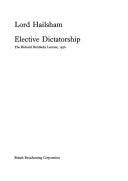
In the 1970s the Conservative politician Lord Hailsham warned of an elective dictatorship - though he did nothing as Lord Chancellor in the 1980s to counter this threat.
We cannot say we have not been warned.
This has been a possible danger since the modern doctrine of parliamentary supremacy became constitutional conventional wisdom.
(Even the main theoretical proponent of parliamentary supremacy - A. V. Dicey - wanted to have referendums built into the legislative process so as to stop governments doing as they wished with primary legislation - though in his case his fear was Irish Home Rule.)
*
So a competent, prepared and briefed incoming illiberal and radical government - either under the Reform Party or otherwise - would have nothing to stop them.
The only limits would be (currently) theoretical ones.
Perhaps the King could refuse Royal Assent - though no monarch has done this for three hundred years.
Perhaps the courts could impugn the doctrine of parliamentary supremacy - though one has to go back perhaps to the early 1600s to have authority for this now heretical view.
But that would be it.
The House of Lords would only have a power of delay.
Nothing would check or balance such an incoming government, short of the King or the courts doing something drastic, which in turn would no doubt lead to a constitutional crisis.
The gatekeepers and the “good chaps” and their counsel and practice of constitutional self-restraint would count for nothing, if any such people would be around at all.
*
Those now in government and parliament know all this (or should know all this).
If an illiberal radical government obtains a firm majority at the next general election, and is competent, then as the law currently stands nothing would hamper them in what they want to do and much would help them.
But those now in government and parliament are doing nothing to limit the scope of such potential damage.
They know this could happen (or should know), yet they are doing nothing to stop it in advance.
And so all we have to rely on is one thing.
Luck.
Brace, brace.
*
Not enough people are seeing this.
Reform will have read the Project 25 playbook and, if they didn't realise they could have absolute power here, they do now. As you say, Brace, Brace.
I suppose a coup d'Etat would be the only way of stopping a truly mad regime, but that's not something we can rely on.