
Why 'A House of Dynamite' is a good film about how those with power make decisions
This unconventional nuclear thriller does something rare in movies
*
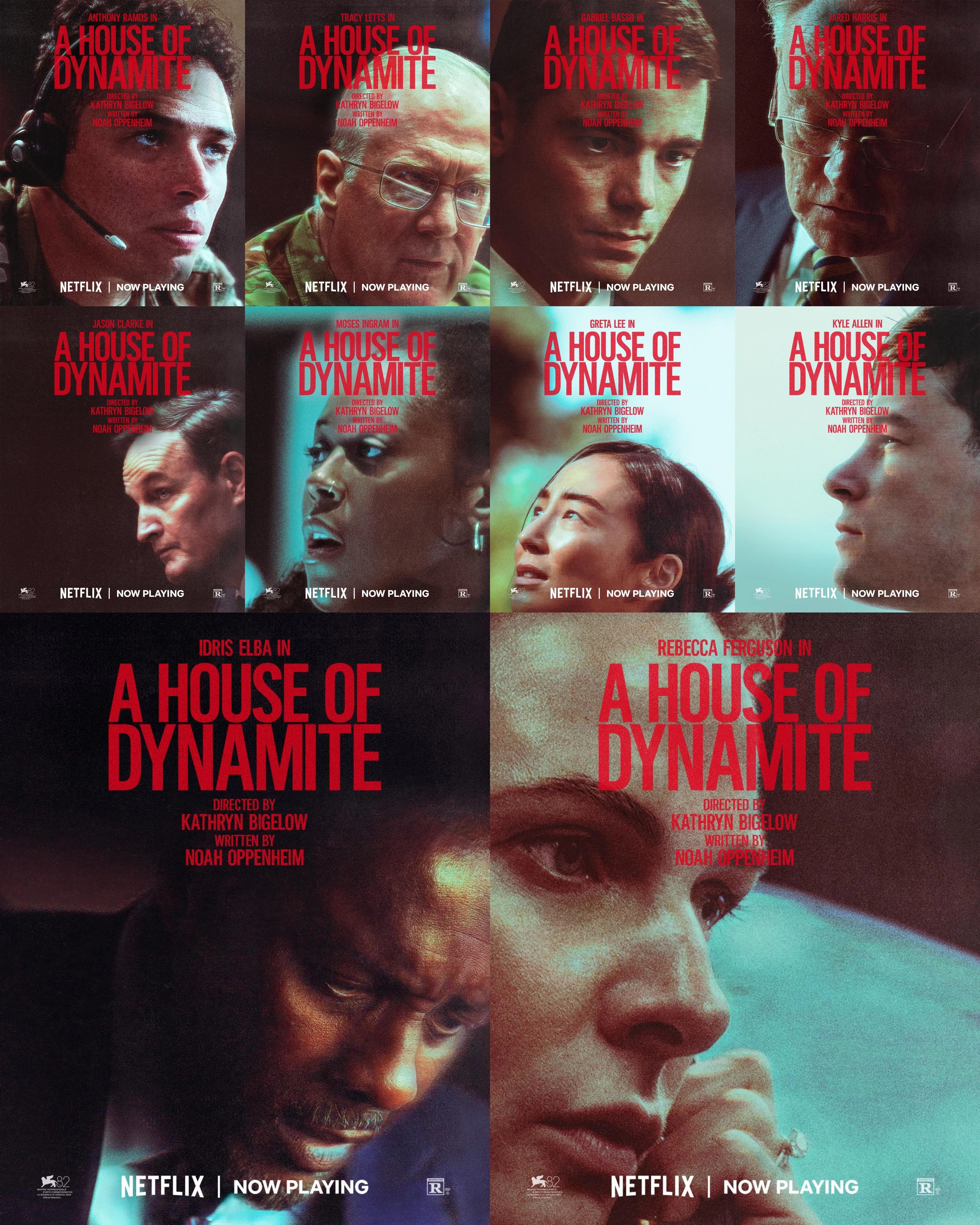
What follows are some thoughts about A House of Dynamite (Netflix).
*
This is not a review as such, but the response of someone who regularly commentates on decision-making by those with political power to a rather good film depicting a decision-making process.
This is a film where spoilers really do need to be avoided, so please be careful with what follows if you intend to watch it.
SPOILERS BELOW
*
A House of Dynamite is a film about decision-making by those with power during a crisis.
The crisis is that an intercontinental ballistic missile is suddenly discovered heading towards the United States from the north Pacific - more particularly, heading towards Chicago.
The launch of this missile was not detected at launch - it is instead discovered mid-flight over the Pacific - and we join the action minutes away from impact.
*
Often thrillers follow a conventional beginning-middle-end structure, with a resolution, one way or the other.
This film does not.
It instead has a middle-middle-middle structure, with no (clear) resolution.
We are not told how this crisis arose. We never find out who fired the missile, or why.
We are also not expressly told how the story ends. There is no explicit confirmation of whether the missile strikes Chicago or not.
(Though one can perhaps infer what happens from the final two scenes.)
The film is entirely about the middle bit: from the discovery of the missile to moments before the expected strike.
We are told the story of what happens in this middle bit from three overlapping perspectives - hence middle-middle-middle - with each segment concentrating on particular decision-makers, advisers, and providers of information.
*
Usually thrillers about those in power attribute a great deal of autonomy to those at the top.
In this film, however, we are shown how information flows from the bottom, about what information is shared and reported upwards, and that information can be incomplete or even misleading.
We also do not have one decision-maker, but several in video conference, jointly and urgently sharing and assessing incomplete information.
And in assessing this information they resort to established processes and policies. Books and folders are pulled out, charts and graphics are used to illustrate options.
But these processes and policies involve choices to be made - they are not railroads, and so it is then back to the individual decision-makers struggling with only having incomplete information.
Various decisions are made: the coin-toss firing of interceptors (which miss), the triggering of a continuity protocol and various evacuations (which interfere with efficient decision-making more than anything), and so on.
(These formal decisions are dramatically placed alongside personal decisions where the same individuals, with the same information, decide to break protocols and contact loved ones.)
When the strike on Chicago becomes a virtual certainty it becomes apparent that one ultimate decision needs to be made, and that decision can only be made by the President: whether to retaliate - and, if so, to what extent and against whom, and on the basis of what (if any) information and for what purpose.
The President is kept off-screen until the final segment - but when he appears we see him dealing with the incomplete information we have watched being put together, and the policies and processes and options that have been briefed to him.
We are not told what ultimate decision he makes.
But we know what materials he has before him. We have seen those materials being pulled together from the bottom up. We know what he has been told and not told. We know what decisions he could make at that point given what evidence has been provided and the choices put to him.
To have this as the end of the film, rather than whether the missile strikes and whether there is a strike-back, is a brave and good way to bring the film to an end.
And it means that it is this final predicament which lingers - an unsettling end, rather than a means to a neater end.
*
What was for me satisfying about this film is how it showed the ongoing interaction between information and processes and human agency. Not one of these three things ever took absolute priority. This balance is rare in any political or indeed legal thriller.
Sometimes a film will come down to the individual brilliance (or otherwise) of a key character, or to the (sometimes suddenly) revealed information being overwhelming, or to the leaden deadening deployment of laws and rules or of bureaucracy.
The full spectrum from a Perry Mason trial to Franz Kafka’s The Trial.
But for there to be a constant balance (and imbalance) between information and processes and human agency from beginning to end is as rare in fiction as it is common in reality.
In practice: information will point in various directions; procedures require the use of discretion with no clearly correct answer; the human beings involved will often be all too human when faced with the horrible predicament they are in - and force of personality will usually only have a limited effect.
As one key exchange in this film puts it, a practical but grave political (or legal) crisis can seem to those involved to be a unstable mix of insanity and realism.
*
This is not a film review blog, and so there is little for me to say about the acting and cinematography other than they were of the high standard you would expect of a production with such resources.
But there was one dramatic detail which the film got right again and again.
Much of the action in this film was in big wide interior spaces - situation rooms, conference rooms, a large politician’s office.
But for those practically in those settings the rooms do not seem large - their perspective is not that of the establishing shot. Instead, being in such spaces quickly becomes closed and claustrophobic.
If you are busy (and stressed) in, say, the grand conference rooms of Westminster and Whitehall, or in the ornate court rooms of the Royal Courts of Justice and Supreme Court, you very quickly forget the quaint environments. You instead become focused on what is immediately in front of you and beside you. The grand and ornate setting is quickly out of mind.
This film similarly shows those in situation rooms and conference rooms from a close perspective - what the individuals can see and hear (and not see and hear).
Films which show a political (or legal) exchange in wide-span can be misleading, for none of those involved will be thinking or acting in wide-span.
To understand decision-making it helps to see what it looks like to the decision-maker, and the information before them.
*
Of course, what does not ring true with this film is that you have a president and a US defense secretary agonising about anything - and it is significant that production of this film began well before the current incumbents of those offices were in place. This is more a Obama or Biden era film rather a Trump one.
One wonders what a similar film with a Trump figure and company would would be like.
*
Thank you for reading these thoughts - a slight departure from the usual content of this blog!
Please become a paying subscriber so as to help this blog continue in the new year.
Thank you for your very valued reflections on this film as well as on the situation as it is revealed. It is fascinating to read your opinion that people in large rooms really restrict their focus very narrowly to the subject being considered while then becoming oblivious of the 'decorations' of the particular meeting room. Another fact that is amazing is that the information not given in full, or not known, but decisions still have to be carried out with all the consequences they carry.