
Thinking about what has happened in Minnesota
What the horrific events of the last few weeks may tell us
*
For the last few weeks those of us outside of Minnesota have had glimpses via social media of the street violence and other thuggery of federal government agents.
As this blog has said before, it is as if we are Christopher Isherwood observing the violence and other thuggery in the streets of early 1930s Berlin. There is what we could see - but there was also what that indicated about what we could not see, and about what may happen next.
As it happens, two gross incidents were actually caught on camera and footage quickly circulated on social media: the summary executions of Renée Good and Alex Pretti.
The shared footage showed both killings to be murders, notwithstanding the lies immediately asserted by federal government figures and their supporters.
Federal government figures and their supporters wanted people to disbelieve what they could see, and to believe what they were told instead.
It was a sheer test of reality: you had to choose between the horrific obvious truth or the comforting official untruth.
And it was not obvious that many would pass this test.
*
The lies told by federal government figures and their supporters about the murders of Good and Pretti had certain features.
One feature was the confidence that the lies would be adopted by others, even if not believed - that the lies would be sufficient for subservient mainstream media outlets to “both sides” the issue.
To its disgrace, the British Broadcasting Corporation even led with “analysis” slop about “sharply contradicted narratives”.
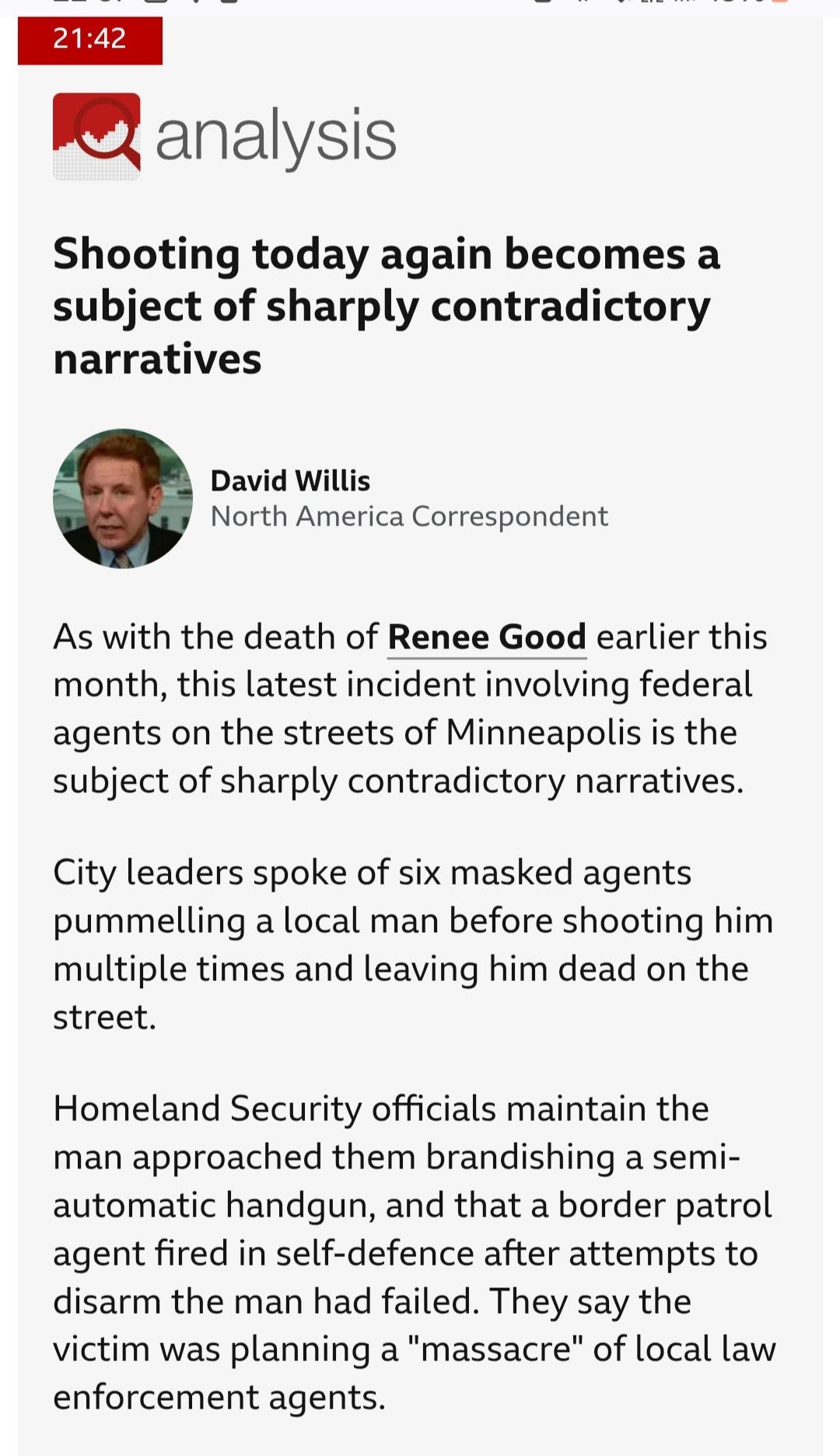
(Source)
The federal government figures and their supporters promoting these lies had every reason to believe this tactic would work, for it has worked so many times before.
But this time the lies did not work
*
One reason the lies did not work was because of another feature of those lies.
The lies come from a certain type of superficial politics.
For example, federal government figures and their supporters talk about “free speech” whilst using the law in various ways to silence and punish unwanted speech; they talk about “non-intervention” but clap and cheer at casual use of lethal force abroad; they talk about “free trade” and “free enterprise” while nodding along with erratic tariff setting; and so on.
Fine-sounding words and phrases which appear to be about first principles are in fact meaningless slogans.
These people simply do not think-through what they are saying - or they don’t care about what they are saying, which is much the same.
And this is where they here came a cropper, to use a British term.
*
One immediate impulse of federal government figures and their supporters in respect of the killing of Alex Pretti was to blame the fact he had a legally possessed gun.
How they must have been so happy at coming up with this line, to combat the concerns of those horrified at the murder.
But so eager were they to “own the libs” they forgot about those who own the guns.
Their snap response was a contradiction of the rights which many in the United States believe to be protected by the second amendment - often small-c conservatives and Republican party supporters.
The witless federal government figures and their supporters did not realise the import of what they were saying in the rush to defend the federal agents who murdered Alex Pretti.
Often federal government figures and their supporters get away with a superficial approach to political principles - but here they tripped up very badly in the eyes of their natural supporters.
*
The lies could not hold.
News reports began to mount of Republican politicians who would not be satisfied with what they were being told to believe.
The camera footage was plain; the lies made no sense.
Something seemed to snap.
*
One theme of this blog and my posts elsewhere is that policing a large population is not easy.
I was brought up in the 1970s and 1980s Birmingham of the notorious West Midlands Serious Crime Squad:
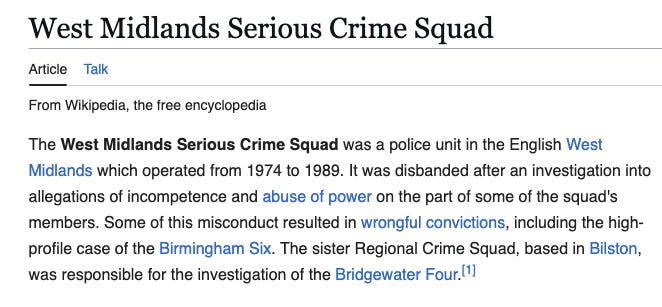
And also during the Troubles, where the Royal Ulster Constabulary and other organs of the British state had little or no legitimacy or support with a significant portion of the people of the north of Ireland/Northern Ireland.
Policing and law enforcement generally requires the consent or at least the forbearance/acquiescence of the community.
Even the hateful and cruel Gestapo and the Stasi derived part of their power from the support - even enthusiasm - of many in their respective communities.
But one thing police or law enforcement agents should avoid is actively alienating the policed.
Casual and provocative brutality at scale is not a sustainable model for any police force or law enforcement agency.
It prompts counter networks of opposition and a loss of legitimacy among neutrals and the usually deferent.
And as in the north of Ireland/Northern Ireland, policing simply breaks down for significant portions of the local population.
*
There now seems to be de-escalation in Minnesota.
The local head of the border force has been demoted and moved elsewhere.
The president’s spokesperson is making conciliatory noises.
The tide seems to have turned, leaving various fools and knaves exposed on the beach.
*
If there is de-escalation then that will be a significant set back for the president and his adviser Stephen Miller in seeking to contrive a pretext for invoking the Insurrection Act.
As I set out here this is their obvious objective - but they also need to have a sound enough basis to survive legal challenge.
It would seem that they thought that fomenting disorder by heavy-handed use of the National Guard and now ICE/Border Patrol would create the circumstances where they could plausibly invoke the Insurrection Act.
But the thing about disorder is that it is, well, disorderly.
By definition, disorder does not go to plan.
And the disorder fomented in Minnesota has resulted in it being now harder for Miller and others to invoke the Insurrection Act: dishonesty has been exposed, natural supporters upset.
The cause of disorder is seen widely as the government itself, and not supposed “insurrectionists”.
Wise politicians avoid instability, as it rarely works out as instigators of instability intend.
*
Just as this eventful month of January has seen something seemingly snap in international affairs, with how Trump was forced to climb down over Greenland and the prime minister of Canada setting out a coherent alternative vision to being bullied by the United States, something seems to have snapped internally in the United States too.
Ruptures inside, and out.
Of course, federal government figures and their supporters are still there, and they can find new ways to misuse and abuse power.
They will still seek to swagger and to intimidate.
Indeed, things may even get worse.
But both at home and abroad there has been a loss of deference to their aggression and dishonesty.
And that deference will be difficult for federal government figures and their supporters to regain easily.
Federal government figures and their supporters should remember that hubris is often followed by some nemesis or other.
**
I hope your cautious optimism is justified. I fear they are building up to preventing (somehow) the likely Democratic majority in the House after the mid-terms.
I wish that this post was not necessary. I suspect that this is a lull rather than a change of direction that gives cause for optimism. But I hope I am wrong.