
The Mueller report was a turning-point where United States history failed to turn
The cynical reframing of the report by Trump's administration worked in our low attention span age
The historian AJP Taylor once described the 1848 revolutions as a turning-point where German history failed to turn.
In the recent political and constitutional history of the United States there have been a few of these non-turning-points.
Most glaringly, one can point to those two failures by the Senate to convict the twice-impeached President Donald Trump.
But the death a few days ago of Robert Mueller reminds us of a particular media-political-constitutional non-turning-point: what happened and did not happen in 2019, when his report into on the investigation into Russian interference in the 2016 presidential election was published.

*
The content of the report was damning of in its details. On this see the useful and important post by former federal prosecutor Joyce Vance published today.
But as with all formal texts, we need to understand both the purpose of the text and its context.
It was a report, and nothing other than a report.
It was not an indictment, and still less a judicial determination.
And the report did the job of a report, leaving it to decision-makers to make decisions based on the report.
The evidence and findings in the report would speak for themselves.
*
But.
The evidence and findings in the report did not get to speak for themselves: they were drowned out.
The report was stymied on release by an effective and cynical countering operation involving the then attorney general William Barr and others.
The report had little chance in our low-attention-span age.
The report had 448 pages and no sound-bite summary.
In contrast, the Barr letter sent to Congress (mis)characterising the report and (mis)describing the content of the report was a mere 4 pages and was packed with quotable lines.

It was a sign of our times that the Barr letter got traction in politics and in the mainstream media and on social media and the throrough investigation set out in the report did not.
Trump even asserted that the report had cleared him.
But Trump’s response to Mueller’s death suggests that he never really believed that to be true.
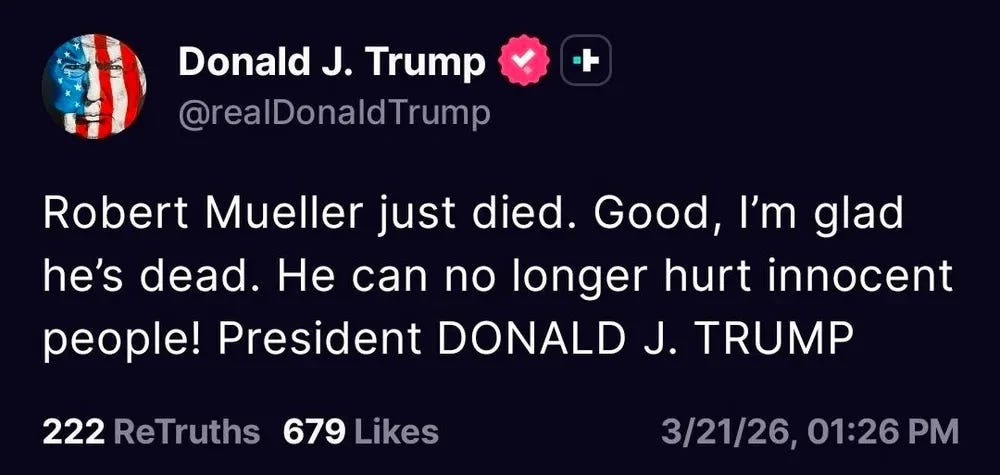
“Robert Mueller just died. Good, I’m glad he’s dead. He can no longer hurt innocent people! President DONALD J. TRUMP”
If Trump genuinely believed he had been cleared by Mueller he really could not have posted that graceless response.
But he doesn’t, so he did.
*
In a way, the intensity of Trump’s response is a testament to Mueller’s diligent work on the report.
As is said on Christopher Wren’s tomb: si monumentum requiris, circumspice (if you seek a monument, look around).
If you want a monument to Mueller’s report look at Trump’s unpleasant response.
But what you don’t have as a monument was any adverse consequences for Trump.
Trump carried on as if the report never was published.
Trump was never held accountable for what was detailed in the report.
The Mueller report and the response to it was a turning-point where American history failed to turn.
The wider Republican Party establishment has to take the blame for proceeding according to Barr's line of thinking. Their party deserves many years of electoral oblivion
Christopher Steele's report on Trump in Russia, which Mueller made great use of, resulted in him getting a massive amount of on-line abuse, too - and yet it's never been refuted.
It probably explains most of Trump's animosity towards the UK.