
Some preliminary thoughts on the Court of Appeal decision on Palestine Action
Why it is important to understand how (bad) law is structured
*
For more independent commentary on contentious legal matters, please become a paying subscriber to this blog.
*
Yesterday the Court of Appeal handed Palestine Action a heavy defeat, reversing a favourable High Court decision.
The Court of Appeal decision is here.
*
This blog does not support Palestine Action or any other proscribed organisation, but this blog often looks at the use and misuse of terrorism and other coercive laws. And on the face of it, it does look like terrorism law is being misused, at least in respect of the mass arrests of people for merely holding signs expressing support for Palestine Action.
For hundreds, if not thousands, of people are facing criminal sanctions for a speech act: according to the judgment 2,000 have been arrested and “there are currently over 700 cases pending in the criminal courts of England and Wales, and many more at the pre-charge stage”. This would appear to be a ludicrous situation and not a use to which one would expect terrorism law to be put.
(Terrorism law is a special body of law, in addition to the general civil and criminal law of the land, which provides the state with powers, rights, and obligations for the particular purpose of dealing with terrorist threats.)
*
On a preliminary reading of the judgment, and having watched (in a boon for the public understanding of law) the Court of Appeal’s decision on YouTube (watch here), these are some preliminary thoughts which this blog may develop further in another post.
*
First, this decision is more in accordance with the deferent general policy of the courts on national security than the somewhat surprising High Court decision. In essence, Palestine Action were lucky at first instance and it was perhaps unrealistic to expect that luck to hold before the Court of Appeal.
*
Second, the fundamental issue is that the restrictions on free expression (for expressing support for a proscribed organisation) is just one of many aspects of proscription. Proscription of an organisation confers on the state a whole range of powers, of which prohibiting expressions of support is just one. So if a proscription is quashed, then the state loses all these other powers.
This means that if a court holds that a proscription has a disproportionate impact on the free expression rights of individuals there is perhaps nothing a court can really do but quash the proscription for other purposes too. A court will be hesitant to do this.
*
Third, if a court can somehow decide that free expression rights are not being disproportionately interfered with, it can avoid quashing the proscription. Here the Court of Appeal stated: “That said, however, as a matter of law, the Proscription Decision will not prevent public expressions of support for the Palestinian cause or opposition to Israel and to the Israeli Defence Force, or demonstrations targeted at Elbit.”
And so the Court of Appeal found that the impact on free expression of the proscription was not disproportionate. The problem was avoided.
*
And this leads to the fourth point.
The real problem here is that section 12(1A) of the Terrorism Act 2000 (which was only added in 2019) should not be in the Terrorism Act at all.
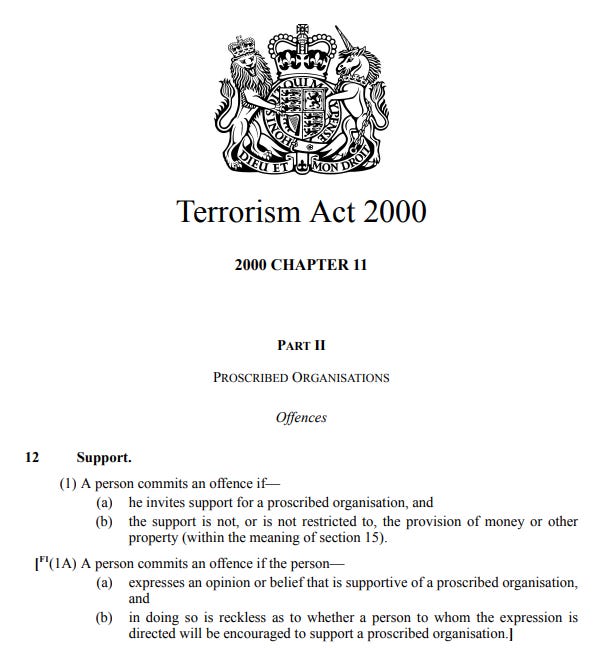
This prohibition on simply expressing an opinion is, of course, problematic generally.
But if a court quashes a proscription because the effects of the section 12(1A) prohibition is disproportionate then all the proscription powers go too.
A court will then strain, as it seems the Court of Appeal did here, to find that the proscription does not have a disproportionate effect.
From time to time a court, such as the High Court at first instance in this case, will quash such a proscription decision for its disproportionate effects on free expression, but such a quashing order is unlikely to survive appeal.
*
Fifth, this appeal decision looks balanced in form (with lots of consideration of opposing factors) but in substance it seems fairly appeal-proof.
(And the current Supreme Court is also not likely to go against the government on national security.)
The Court of Appeal had what was a ‘strong’ bench, with the Chief Justice, the Master of the Rolls, the Vice President of the Court of Appeal Criminal Division, and two other senior appeal judges. Usually an appeal bench is of three judges, but here it is of five, and they were unanimous.
Unless this case goes to Strasbourg then this decision looks like the end of the road.
*
And finally, the Court of Appeal in this case made, in passing, some ill-advised historical generalisations about the Suffragettes and other groups.
This historical dabbling will rile anyone with the relevant knowledge of history, and it should have been avoided by the judges, unless it was relevant to a question they had to decide. But to make such points for the purpose of illustration simply made the judges seem historically illiterate. The judges may well come to regret making those points.
'On the face of it, it does look as if terrorism law is being misused, at least in respect of the mass arrests of people for merely holding signs expressing support for Palestine Action.' Your restrained words are developed and illustrated in a most helpful way. Thank you, DAG. Terrorism laws in the hands of any politicians are dangerous, in my opinion; and if politicians are then supported by the higher judiciary - like the Supreme Court in Trump's USA - a variety of historical precedents stare out at us.
Thank you for your comments.
I too listened to the judgement and found it to be rather more sensible than the High Court decision. I have no objection to proscription of what is a violent organisation - with sledgehammers as the tool of choice.
Like you however I am concerned at the wording of section 12 (1A) of the Terrorism Act 2000.
It has the strange effect of allowing someone to approve of a proscribed organisation, but not to try to convince anyone-else that he’s right unless he’s at least fairly sure that he will fail to do so.
He can also seemingly ask for money or materials for the proscribed organisation under Section 12 (1), but section 12 (1A) would prevent him from explaining how he justifies that request: if successful he would thereby have encouraged support for the proscribed organisation - unless he was talking to the converted.
Apart from it being very poor drafting, it means that a whole load of pensioners holding up banners supporting Palestine Action are in breach of S 12(1A). No doubt it was a cunning plan on the part of Palestine Action to encourage their support in order to give the impression that they couldn’t possibly be a terrorist organisation – how could it be, granted the amount of white hair, dog collars, Zimmer frames and arthritis on show? Surely they would not approve of violence. I cannot see, however, what the public interest is in actually prosecuting them.