
Six proposals for improving public procurement
Yesterday we saw what was wrong - here are suggestions for what could be put right
*
This is a sequel, of sorts, to the post here yesterday on what is wrong with public procurement.
Here this blog will set out six things that could be done to improve public procurement.
To an extent, this is a mirror of yesterday’s post, but it is still worth setting out something positive against (the usual lot of a law and policy blog) what is negative.
*
The first thing would be transparency of commercial terms.
Both the Freedom of Information Act and the Public Procurement Act should be amended so as to remove exemptions from public disclosure of the terms of any awarded public contract.
As this blog stated yesterday, contractors get enough benefit in the amounts of public money and (generally) the reliable revenue stream of public contracts. The price for these benefits should be transparency.
The exceptional circumstances where information needs to be withheld then other exemptions could apply.
Indeed, there should perhaps be a duty for the full contract terms (including commercial terms) to be published between the contract award and the start date.
*
The second thing would be transparency of any intention not to advertise and compete a contract.
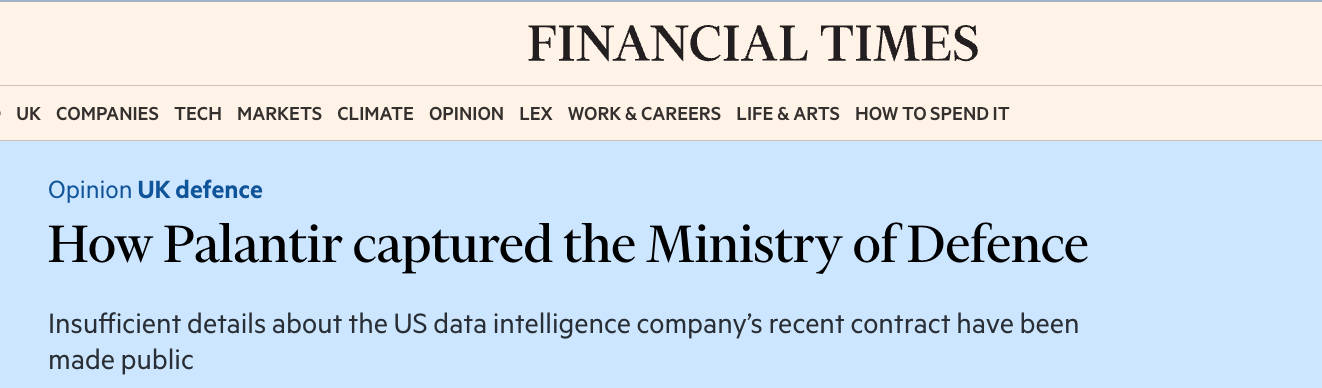
When - as with the Palantir contracts with the Ministry of Defence - a decision is made by a public authority not to hold a competition or advertise a tender, that decision should itself be published before the decision takes effect.
*
The third thing would be to widen the class of those able to challenge a tender decision.
Generally, only disappointed tenderers can challenge a tender decision. As such, it is effectively a private law right for a potential contractor that has suffered damage by a wayward decision.
But: think about the phrase “public procurement” - and ask yourself what difference does or should the word “public” make?
The fundamental reason for public authorities having special duties of transparency and equal treatment and so on in public procurement is that these duties are in the public interest.
Public procurement should not just be about the closed - and indeed often cosy - club of established tenderers and their repeat customers.
Such tenderers have no incentive to upset a past and potential customer by challenging an adverse procurement decision, whatever the circumstances.
Indeed, the law of public procurement is practically geared for there to be very few challenges to procurement decisions.
And a legal regime without practical remedies can hardly be said to be a legal regime at all.
*
The fourth thing would be for public authorities to put more resources into practical contract management.
There is little or no point in a contract having a range of provisions to enforce against a supplier if those provisions are never enforced.
It is all very well pointing to a black-letter contract if everyone involved - officials and suppliers - know in reality the public authority will never actually assert its contractual rights.
And contract management is a skilled and important role, not an afterthought - and it is a false economy to not pay contract managers the appropriate rate for the job.
Yet public authorities who will generously budget for payments to a supplier will not make adequate provision for internal contact management.
And those public authorities then wonder why they are done-over by cynical contractors acting in their commercial self-interest.
Related to this: contract management reports should also routinely be published or disclosable on request - for there is as much a public interest in transparency of ongoing contract management as there is in the terms of the contract originally let.
*
The fifth thing would be for all potential public contracts a formal stage where a reasoned (and public/published) decision as to whether a COTS (commercially off the shelf) product is available.
Part of the problem with information technology/intellectual property (IT/IP) contracts is a casual and naive view by many in public authorities (though not experienced procurement professionals) that bespoke IT/IP development is somehow preferable and easy to manage.
It ain’t.
And the public authority is then often then captured by the supplier, with their hawked maintenance and support schemes, and with their dependency-culture proprietary products.
*
And the sixth thing would be a greater (and more enforceable) emphasis on the principles of public procurement - equal treatment, transparency, competitive tenders, no bias towards incumbents - rather than formal compliance with elaborate statutory codes.
The important thing is that the principles are complied with, not whether a detailed prescribed checklist process (that will only benefit well-resourced tenderers) is followed.
Too often in public procurement, as well in other areas, there is a victory of form over substance.
The problem, for example, with the Covid/PPE contracts was not so much that they did not follow detailed processes, but that the very principles of public procurement were abandoned.
***
I would like to write more posts about public procurement topics, including proverbial ‘deep-dives’ on particular contracts. Not many commentators and too few journalists know their way around public procurement.
If you would like this too, then please become a paid subscriber, as such posts take time and opportunity cost, and can even carry legal risk.
Thank you for your excellently reasoned post on some ideas to improve public procurement. As always, you remove any points of conflict and show possibile answers to us.
Standard vs bespoke contracts often already solve the transparency issue. If they miss some consumer protection then better the government spending their energy fixing this for themselves and everyone than crafting a private contract that won’t be enforced properly anyway.
Great series.
Ps
Typo alert at “asset its contractual…”