
Six things wrong about public procurement
What is wrong about public procurement - and why it can be hard to do anything about it
Public procurement, like constitutional law, should be boring.
It should be about the mundane everyday activity of public bodies purchasing things so that they can fulfil their public functions.
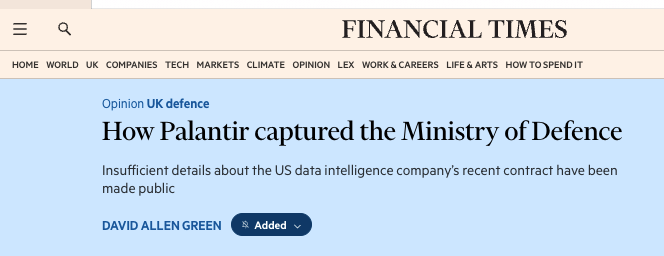
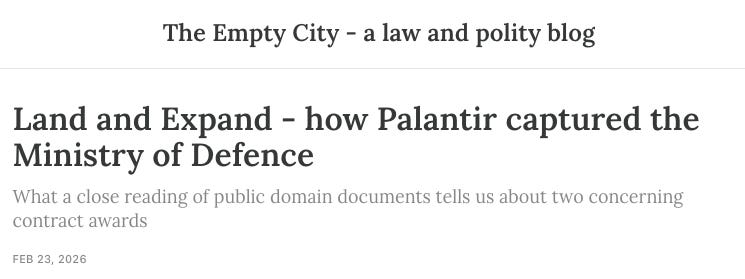
But it is currently exciting, and my pieces at the Financial Times and here on the Ministry of Defence contracts with Palantir were disconcertingly popular.
And do this seems as good a time as any to set out some more general concerns about public procurement - though those who follow my drivel on social media will be familiar with some of these points.
But as a preliminary remark: nothing which follows is disparaging about the greater number of those engaged in public procurement and contract management for public authorities whose professionalism keep things from being a lot worse. The public are lucky to have you.
The points below are generally about the faults of a system - and about how it benefits cynical contractors acting in their commercial self-interest and about how non-procurement officials and their political masters lack realism.
The points below are not about those that somehow stop greater abuses from happening.
*
The first point is about money.
Loads of money.

And as with the fog at the start of Bleak House, money everywhere.

Billions - not just millions.
If you can get a lucrative public services contract, you and your pension plan and your family are not just made for life, but also for generations.
Public procurement is an absolute geyser of cash.
And - this is the important thing - central and local government are good reliable payers.
There are hardly any defaults, and there are hardly any early terminations.
Many contracts just rollover, just like the public authorities that let them.
Public authorities suing on a contract is almost unheard of, more is the pity.
Sometimes a public authority will assert its contractual rights - and this will grab attention like any rare event - but mostly public authorities will keep funnelling the money to contractors.
And because central and local government are good reliable payers then the canny contractor can use the revenue stream effectively as security for other aspects of the business.
The returns on savings or an investment fund are nothing as the percentages a contractor will make on a public contract, especially if they then sub-contract the actual provision of goods, services or works at a discount to sub-contractors - who, in turn, are sometimes made up of the very same people who provided the same things for the public authority in-house before being out-sourced.
Some may complain (and no doubt will complain below) that the above is a horrible caricature: but in my experience there is enough truth in the depiction set out above for it to be offered as a concern on this blog.
And it gets worse.
*
The second point is the general lack of transparency.
Public procurement for no good reason whatsoever is shrouded in secrecy.
Routinely the facts about public procurement - that is when huge amounts of public money are spent on things (supposedly) so public functions can be discharged - are not disclosed to the, well, public.
And this is an attitude often at the highest levels of public authorities.
The magic phrase “commercial confidentiality” is constantly invoked, often by those who want you to nod-along with their mock-earnestness.
But “commercial confidentiality” in public procurement is utter balderdash and complete flapdoodle - at least after the contract has been let.
And this secrecy cloaks so may inefficiencies and abuses - on both sides of the transaction.
But those involved know that any attempts to force public disclosure of commercial information about these contracts can be avoided, at least in any timely way.
In principle - because of the amounts of public money involved and the need for public functions to be discharged, as well as because of pretty basic things like transparency and accountability - there should not be as a general rule “commercial confidentially” in public procurement.
The contractors get the benefit of huge amounts of cash, paid on a regular and reliable basis. They really should be happy with that.
And so the price of such contracts for the contractor should include full public transparency - unless there is a reason other than commercial confidentiality for non-disclosure.
*
The third point is that the law and practice of public procurement will often favour a small group of large providers - often with deliberately forgettable corporate names - who can afford the risk and the expense of participating in elaborate procurement exercises without guaranteed return.
Some procurement exercises with their multitude of stages and questionnaires and voluminous tender documents cost a small fortune for a bidder.
Public procurement should be about non-discrimination and avoiding bias, but - counterintuitively - the complex rules to give effect to such laudable aims have the practical effect of excluding almost all providers.
Like how profit and sustainability rules in football have the practical effect of favouring already established clubs - disclosure, Aston Villa fan here - the rules of public procurement have the effect of favouring a small group of established providers.
*
The fourth point is about the closeness of some (but not all) contractors and public authorities - with the famous “revolving doors”.
Those who let contracts really should not then work for the contractors to whom those contracts were let.
Even if the integrity of such individuals is beyond reproach, unbiased public procurement - like justice - not only needs to be done, it needs to be seen to be done.
*
The fifth point is a personal bugbear about contracts which involve informational technology and intellectual property (IT/IP).
There is a tendency by non-procurement officials in public authorities - and even their political masters - towards bespoke IT/IP development.
And this suits the contractor just fine - especially if the contractor retains the property rights and gets to charge for testing and ongoing management.
And so sometimes you end up with public authorities beholden to that contractor for the IT/IP development long after the term of the initial contract.
The public body is captured.
Of course, public authorities should use, where possible, commercially-off-the-shelf (COTS) products or open source software.
And if there is a need for proprietary bespoke software then there has to be robust exit management plans and licensing arrangements so that a public authority does not become dependent on one provider.
But it seems some non-procurement officials and their political masters like gleaming new things, with wish-lists of white-boarded specifications.
Aspire-ware, vapour-ware.
Public authorities should stick to COTS products or open source software where possible, and if there really - really, really - has to be an exception, then considerable thought needs to go into not only the terms of the contract, but also into the practical contract management and re-letting of the contract, so as to avoid capture by a supplier.
*
And now to the sixth point, the saddest point of all.
The only thing worse than having (often inflexible and elaborate) public procurement rules is having no public procurement rules at all.
The recent experiences of Covid and the abuses of PPE show what happens when the rules are suspended and an anything goes approach is adopted.
The sheer amounts of cash at stake mean that corruption is pretty-much inevitable.
Ideally one would have disinterested public authorities picking-and-choosing the right supplier without the fuss of public procurement rules; but instead of picking-and-choosing you will get pick-pocketing, and at a vast scale.
As some Victorian statesman once said, not all problems have solutions.
*
And in conclusion: we are fortunate that because of the professionalism of many procurement officers and contract managers within public authorities that things are not a lot worse.
But non-procurement officials and their political masters really need to get a grip on what is going on.
For contractors, acting cynically in their own commercial self-interest, know exactly what is going on.
As a public procurement official in the NHS I can only agree with this whole post.
In my experience trying to support procurement I can add one huge issue to the pile- the under resourcing of procurement and management functions. There is a vast public narrative saying that all management is wasteful. However procurement - done right - and contract management - again done right - with the time and headspace to look ahead and do things right is in fact a massive saving.
I read once that as a rule of thumb, about 10% of the contracts value is the right amount of resource to put towards managing to and I can say that the NHs is absolutely nowhere near that level!
However, it is considered boring and process and can slow things down and stop desired outcomes from happening automatically. And so it is after the first team on the chopping block
I'd add another factor, at least as important as your points, and which many ways underlies and enables your points: the uncertainty of the specification of the products and services being procured
As a consultant working both sides (by turns, not simultaneously, tho one employer wanted just that) the uncertainty creates additional risk, historically managed as exceptions to the contractual process
But of course, such exceptions are a feature of any contract whose period extends beyond a few weeks
Consequently, suppliers are able to increase the value of a contract, often by factors rather than mere percentages
(There was a story, likely apocryphal but with enough plausibility, that a supplier promoted the bid leader to partner for winning a public sector contract. Subsequently, the leader of the delivery team earned partnership by doubling the billing over the period)
Therefore one might conclude that variations should not be exceptions, but the norm. Exceptions should be handled within the contractual delivery process, without generating additional payments
This begs the question of what value to then place on the contract
That should be determined by the business case - the buyer cannot justify spending more than the prospective savings or increases in productivity
The joint teams should therefore be constrained, absolutely, to work within the budget, to deliver the best solution to meet the overall requirement
That requires the client side team to understand the benefits demanded of them and to make routine decisions about how to deploy the supplier team (and their own team) to meet the requirements as best they can
Or, to stop the project before incurring excessive costs to the public purse