
Must Prime Ministers fail?
A constitutionalist perspective
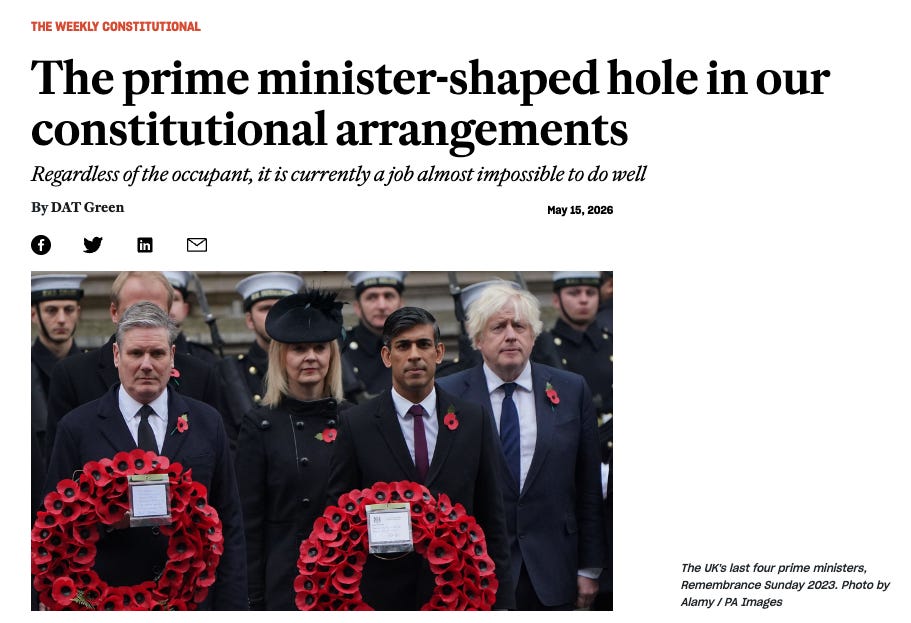
This was a week when we got to consider the office of Prime Minister, again.
The current occupant has somehow, through a sequence of decisions and non-decisions, made themselves a lame duck - despite a thumping majority two years ago and three years of a parliamentary terms to go. It is quite an impressive under-achievement, given the powers and privileges a Prime Minister has at their disposal.
But for a Prime Minister to be on their way out is, as this blog has stated before, not unusual. Since 1974 every single Prime Minister has come to office or left office between general elections, and recently both. The classic model of a Prime Minister coming and leaving power at a general elections has not happened in over fifty years.
What, however, is becoming distinctive is the speed with which Prime Ministers come and go. Since 2016 the churn has been quite remarkable. The long terms of Thatcher (eleven years) and Blair (ten years) now seem form another age.
Why?
*
Alan Beattie of the Financial Times observes:
“If you think the UK changes PMs too often, which of the last 5 departures were mistakes? Cameron shd have stayed after losing the referendum? May after deadlock with her deal? Johnson after Partygate? Truss after meltdown? And Sunak lost an election.”
He makes a good point: circumstances and events explain each of the recent changes which, taken together, appears to be rapid churn, if not turmoil.
And Beattie links to this fine article by Robert Shrimsley which avers:
“Britain is not ungovernable. It has just been very badly governed. In particular, it has endured a decade of woefully inept leadership.”
The problem thereby is not so much with the office, but with its occupants.
*
Over at his Substack Sam Freedman offers a view which mixes structural and personal points:
“Why do prime ministers keep failing?
“[One suggested reason] is that we’ve just had a really bad run of leaders who either lacked basic political skills, were temperamentally unsuited for the job, or were Liz Truss.
“[But] there are some deeper structural problems that are undoubtedly making it harder to be prime minister.
“[…] there are some uniquely British challenges with being prime minister that make it harder than necessary. The role has evolved in a typically haphazard way over the decades, without much thought as to its purpose.”
Freedman’s analysis is typically well-informed and insightful.
*
My view, which I had already put together before I saw any of the above commentators, is that there is structural gap in our constitutional arrangements where the office of the Prime Minister should be.
Indeed, until the lifetimes of people still alive, the constitutional fiction was that the office of Prime Minister had no legal existence at all.
Other than with a few express statutory powers, the powers (and privileges) of the Prime Minister are still almost entirely to be inferred from the royal prerogative and from being the head of a Commons majority. Prime Ministers can remove ministers (and civil servants) from their jobs and impose whips on backbenchers, and make certain other decisions.
But unless you have an individual of exceptional charisma and/or capacity, coupled with reliable allies in other cabinet jobs and substantial backbench support, a Prime Minister is vulnerable to political downturns.
In this way, despite what pundits sometimes say otherwise, we very much have a parliamentary and not a presidential system.
And so when one faces a sequence of difficult political challenges, as the United Kingdom has had since 2016, the tendency will be for Prime Ministers to fold.
Part of it is as Beattie and Shrimsley point out: the occupants have not been up to the challenges they have faced. But the occupants also have not had firm places to stand.
The job of Prime Minister is, for the reasons detailed by Freedman, becoming more and more difficult to do. There is no particular reason to believe any successor to the current occupant will do any better job. (It is telling that many think the only viable candidate is not one of the already elected members of parliament.)
And so, as I set out, over at Prospect, there is a prime minister-shaped hole in our constitutional arrangements.
*
The "Britain is ungovernable" discourse is, to be frank, disingenuous and self-serving to the point of being slimy. Saying that Britain is ungovernable is like saying "A plane cannot be built out of wet tissue paper, therefore planes cannot be built and human flight is impossible". It's like sitting an A-level maths exam, declaring that it is unacceptable for you to write down or even think of any numbers in the course of working out the answers, and then complaining when the exam board award you a U for the paper.
If you narrow the range of your thought to the right-wing dogma which has destroyed this country, then of course you won't fix anything and will only make things worse; the disease cannot be cured with more of the disease. And it's not even like you have to be especially imaginative, as one solution is simply to bring back the social democracy which this country had for decades.
If we were a country that provided everybody what they need to survive as of right instead of denying it to them, that invested in its people rather than grifting them for every penny they're worth, that harnessed people's potential rather than squandering it to no purpose, then we'd be able to rebuild the social contract and have a functioning society and economy again.
This isn't impossible and it isn't unreasonable. It's what we had before, it's what we need again, and it's what we're owed.
The Labour Party is of course ungovernable. People with strongly held principles don't make an easy team to manage. We all tear up our membership cards for a wide range of incompatible reasons soon after a new Labour leader is elected.
The last 6 pms have struggled with running an effective govt while somehow delivering the Brexit that a majority of the electorate had voted for. Clearly that was (and remains) impossible. Who can govern a country of which 52% has shot you in the foot, and is still apparently holding the gun?
Interesting that one Labour pm who is still held in respect is Clem Attlee, a man of almost zero charisma or media presence. It's hard to imagine him surviving today.