
How a county council has obtained an injunction against those hoisting flags on the public highway
A guided tour of the High Court injunction against "persons unknown"
*
Please note these posts take time and opportunity cost to publish. For more independent legal commentary like this (not written by an AI bot) please become a paid subscriber.
*
UPDATE - since the post below, the Council has now published other legal documents regarding the injunction here.
*
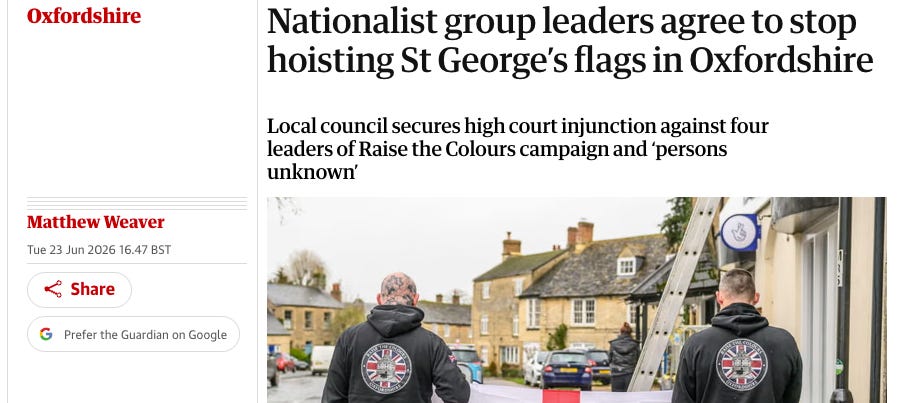
Yesterday it was reported that Oxfordshire County Council had obtained a High Court injunction against those placing St George’s flags on the public highway.
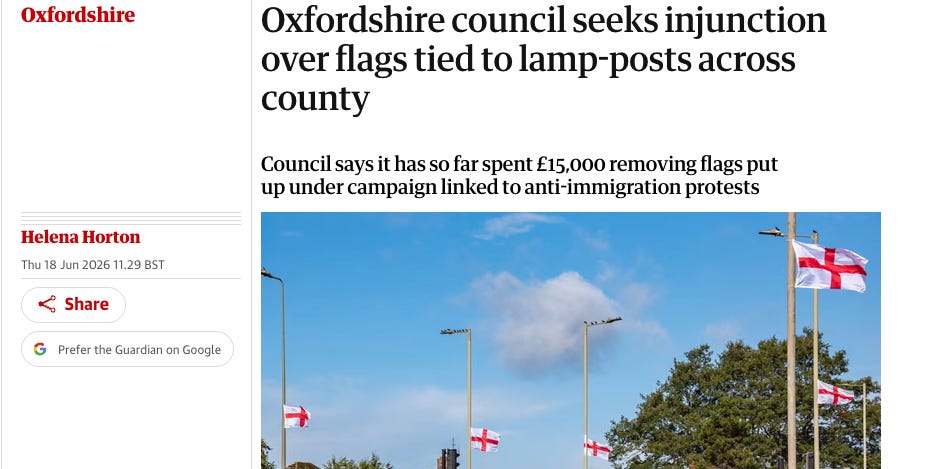
This followed the earlier news of the council’s application.
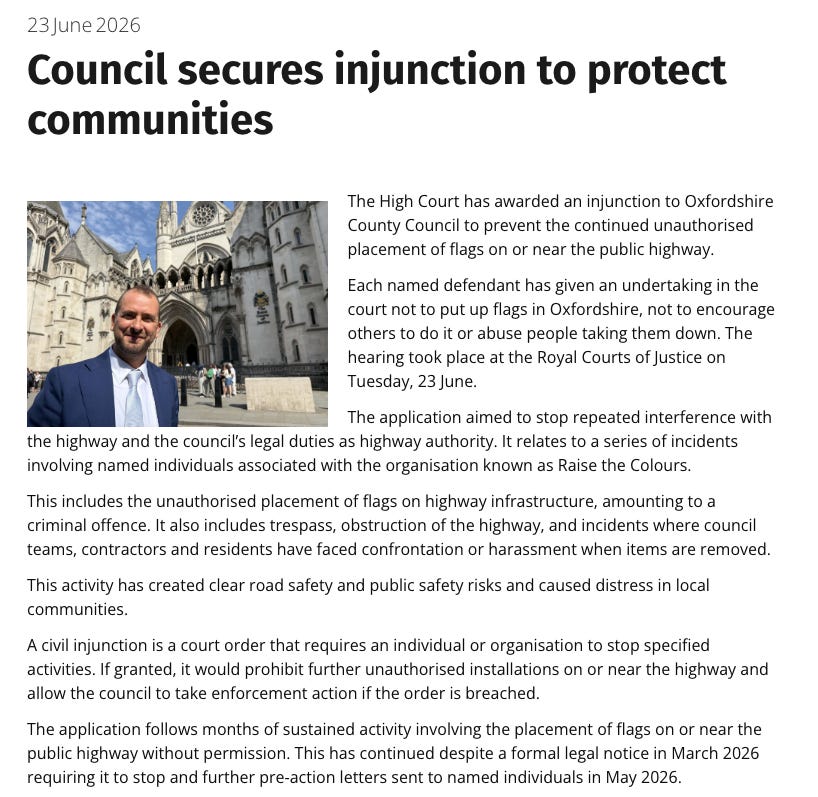
The council itself published a helpful and detailed post on the injunction on its own site, which is worth reading in full (excerpt below).
*
This blog has now obtained a copy of the Order of the High Court, and it sets out below what the Order says and what can be inferred about the case from the Order.
Although the Order is a public document, and so can by obtained by anyone reading this post, this blog does not propose to publish the Order in full as it names various natural persons, and this is not the sort of legal blog to name natural persons caught up in litigation unless necessary. This blog is more concerned with the legal issues.
*
THE PARTIES
The applicant for the Order was, of course, the council.
The respondents were four named individuals, but also as a fifth respondent “persons unknown” who are
“intending to
(i) attach flags to highway structures or mark flags on the highway in the county of Oxfordshire,
(ii) harass members of Oxfordshire County Council or
(iii) obstruct or harass employees or contractors of Oxfordshire County Council involved in the removal of flags from highway structures”
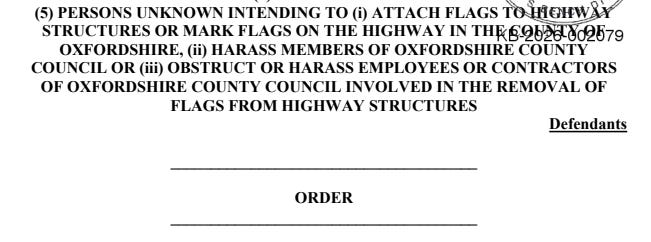
The Order is thereby only against the “persons unknown” as three of the four named respondents all gave undertakings to the court on the terms of the injunction, and the fourth respondent indicated that they too would give an undertaking.
An undertaking generally has the same legal consequences for a party as an injunction, and with similar sanctions for breach. A court will often allow a respondent an opportunity to give an undertaking in lieu of an injunction, and that is what happened here. The four named respondents will be as bound legally by their undertakings, as if an injunction was made.
(And giving an undertaking has beneficial costs consequences for the respondent, rather than them refusing and requiring the court to make the respondent to be a party to an Order.)
That the Order was still required despite the undertakings was because of the “persons unknown” element.
*
THE MAKING OF THE ORDER
The Order was made by Mr Justice Dexter Dias of the King’s Bench Division of the High Court, and it was sealed on 23 June 2026.
The Order does not refer to any particular legislation (for example highways legislation) under which the Order is made, and so it may be presumed that it is under the general jurisdiction of the High Court.
And although the claimant is a public body, it appears that the Order was made not by the Administrative Court, but by the (general) King’s Bench Division of the High Court which deals with (general) civil and private law matters.

It is an interim Order, and there is a further hearing listed for 9 July 2026. This means that, in theory, this Order is not the end of the matter and that the Order “holds the ring” (to use the usual phrase) until the claim of the council can be tried. In practice, however, many claims end once an interim Order has been secured.
When making such an interim Order, a court usually has to have regard to the “balance of convenience” of the parties, and here the court says expressly that it found the balance of convenience against “persons unknown”.
*
WHAT IS ORDERED?
Until a trial takes place (which may or may not take place), or until the court orders differently, “persons unknown” (as defined above in the block quote):
“shall not:
(a) attach any flag or cause any flag to be attached to any highway structure;
(b) paint or mark any flag on any of the highways;
(c) obstruct the Claimant’s officers or contractors from removing flags from highway structures;
(d) cause harassment, alarm or distress to the Claimant’s members or to officers or contractors of the Claimant who are or have been involved in the removal of flags from highway structures, including the decision to remove them.
(2) Persons unknown (as defined above) shall not encourage any other person to act in away prohibited by [the paragraph above].”
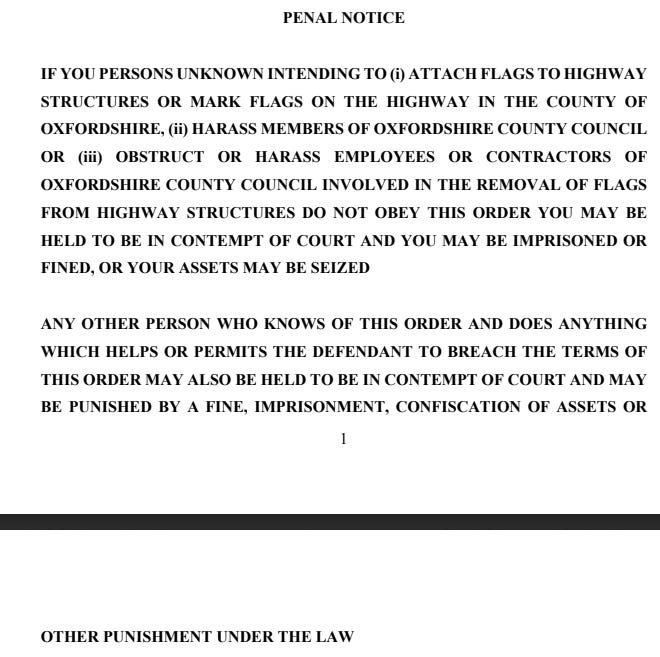
If “persons unknown” do any of these things they will be in contempt of court, which may mean imprisonment or a fine, or the seizure of assets. This is set out in the important penal notice on the front page of the Order.
The “highway” and “highway structures” are defined in the Order as follows:
“In this Order (1) references to highways are to highways in the County of Oxfordshire for which the Claimant is the highway authority; (2) “highway structures” means lampposts, lighting columns, street signs, trees, barriers, railings and other physical structures in the highways.”
As such, this Order does not cover the placing of flags on any private property.
The Order does not mention any points about freedom of expression or expressly conduct any balancing exercise under the Human Rights Act. It looks like it was treated as a straight private law claim by the council.
*
HOW ARE “PERSONS UNKNOWN” TO BE BOUND BY THE ORDER?
This raises an obvious question of how are “persons unknown” to be made aware of this Order? The general rule is that a person cannot be bound by an Order unless they have notice of it. This notice can be actual notice or what is called constructive notice.
The Order deals with this as follows (hyperlink added):
“Service of the claim form and this Order on persons unknown (the Fifth Defendant)
Pursuant to CPR rr 6.15 and 6.27 the claim form, interim injunction application and this Order shall be served on the person unknown by the following means:
(1) The Claimant shall set up a dedicated webpage on its website giving access to the claim form, particulars of claim, supporting evidence, and this Order.
(2) The Claimant shall notify the groups known as Raise the Colours, Raise the Colours Oxfordshire and Oxfordshire Flying Squad of this Order by email, giving notice that the documents relating to the claim and this Order have been placed online and providing a link to the relevant webpage.
(3) The Claimant shall publish details of the claim and Order on LinkedIn, Bluesky, Facebook, Nextdoor, WhatsApp and the Claimant’s fortnightly newsletter for residents “Your Oxfordshire” and the Claimant’s news page with links to the relevant webpage.
The claim form shall be deemed served on the Fifth Defendant 3 days after steps (1) to (3) above have been completed, which shall be done by 4pm on 24 June 2026.
(Interestingly paragraph (3) does not include X, formerly Twitter.)
The council does not appear to have set up a dedicated webpage yet, but this blog will add a link to it when it does.
A guidance note to the Order adds:
“Effect of this Order
A Defendant who is an individual (including persons unknown) who is ordered not to do something must not do it himself or in any other way. He must not do it through others acting on his behalf or on his instructions or with his encouragement.
A Defendant which is not an individual (including persons unknown) which is ordered not to do something must not do it itself or by its directors, officers, partners, employees or agents or in any other way.
Parties other than the Claimant and Defendant
Effect of this order
It is a contempt of court for any person notified of this Order knowingly to assist in or permit a breach of this Order. Any person doing so may be sent to prison, fined or have their assets seized.”
And so it is by a combination of the Order and the Council doing what it can to publicise the Order that “persons unknown” are to be bound by the Order.
*
Given this appears to be an Order of the High Court in respect of its general jurisdiction in respect of a general private law claim, it would seem what Oxfordshire County Council has done here could be done, in principle, by any other local authority.
*
This page will be updated as more material is available.
*
Thank you for keeping us informed on legal matters concerning public places. As always, you make it very detailed and enjoyable to read.
Thank you for the clear explanation. I hope it can be replicated across other authorities now Oxfordshire CC has shown the way.